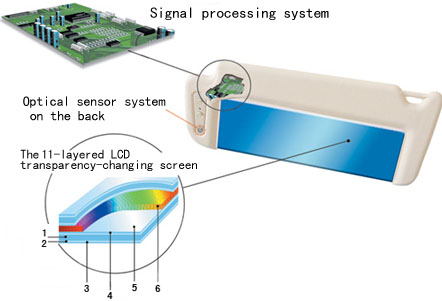
(A Exploded View for the Product)
Signal processing system
Optical sensor system on the back
The 11-layered LCD transparency-changing screen
1. Natrium-free glass
2. Plastic protective coating
3.Optical polarizing plate
4. Transparent electric membrane
5. Alignmentmembrane
6. Liquid crystal molecule
1.
Optical signal part: It mainly consists of photosensitive sensors that
convert the exterior optical intensity to an electric current, which
transmits to the signal processing system.
2.
Signal processing system: Mainly consisting of integrated electronics,
this part is responsible for analyzing; optimizing and processing the
signals received and then transmitting drive signals to the liquid
crystal control and drive part.
3. Liquid crystal control and drive part: According to the signals of the
signal processing system, this part will generate an electric field
through the evenly distributed conductive membrane on the N atrium
-free glass to control and drive the liquid crystal molecules and to very
their alignment, thus varying its visual transparency.
4. LCD screen part: This part consists of an 11-layered flat structure.
- Two 1-mm-thickNatrium-free glass substrates
- A special liquid crystal injected between the Natrium-free glass substrates with approximately 15 microns' spacing
- There is a transparent electric membrane inside Natrium-free glass, which can generate electromagnetic field.
- The transparent electric membrane is attached with a vacuum evaporated alignment membrane in order to control the ordered liquid crystal molecular arrangement.
- The outside of the Natrium-free glass is optical polarizing plate to disperse light in different directions.
- There is high-molecular sticking coating inside the polarizing plate to prevent the display screen from being damaged.
The 11-layered structure is an organic body that changes transparency wthin 0.15 sec under the control of the signal processing system.
5. Power supply: The System incorporates two possible options for the power source. The first is to use two AAA batteries within the AGS itself. The second is to use electricity provided by the vehicle.
6. Connection part: This part connects AGS to the interior of the vehicle;
it includes control buttons, such as “On/Off” and “Day/ Night”.This
part can be specialized design according to various auto types.
Technical Specifications
|
Load voltage |
3V — 12V adjustable |
|
Rated capacity |
0.3mw |
|
Transparency changing time |
0.15sec |
|
Perspective angle |
90 ° |
|
Relative humidity (HR) |
85% |
|
Serviceability temperature |
-22F-140F |
|